While attending a workshop in Wyoming, David Black showed his light painting work. The effect is very beautiful and reminds me of an old work master painting with deep rich tones and a glowing light.
The technique for light painting is simple. Choose (or setup) a scene in a dark room (or night). Set your camera for a long exposure and small aperture. Release the shutter and start painting the scene with your light source. If you have never light painted before, choose a small scene and a small flashlight. If you are shooting digital, you can fine-tune what you highlight and your exposure after each shot.

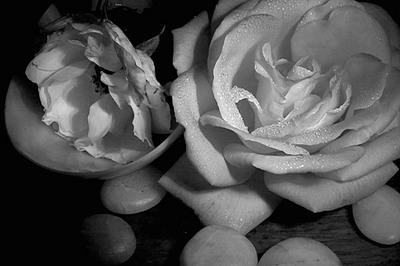
I worked with a friend, Aphra, from the camera club. We setup a few roses and alabaster rocks in a dark hallway. For the exposure, I chose ISO 100, 20″ and f32. My results were underexposed but retrievable in Photoshop. Given this length of exposure, you definitely need a tripod. For our first attempts, we use a small flashlight that I keep on my keychain. The previous image was about the third attempt after fine-tuning the exposure and where we wanted to light paint.
I was curious if the interesting lighting effect would survive the transformation to black and white. It did but I miss the rich golden quality of the light.
<
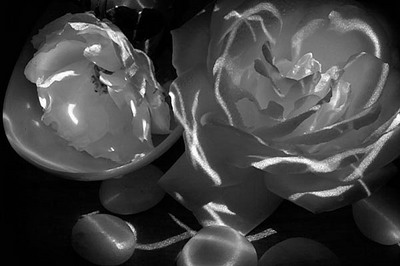
At this point, Aphra wanted to try painting with a more concentrated beam than my little flashlight provided. So we tried with a small red laser pointer. You can clearly see the beam of the laser moving around. In particular, I was surprised to see how the laser bean ‘pierced’ the alabaster rock.

Personally, I did not like the overwhelming red of the lasered scene so decided to try a black and white conversion. I liked the black and white version much better. I think the laser pointer gives and even more unusual effect than the penlight.
 DorothyPhoto