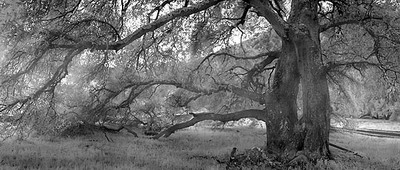
For those that do not want to read, my recommendation is try infrared. Digital infrared is great because you can see and adjust your results right away. Plus, it is fun!.
After much consideration, I decided to convert my Canon D30 to an infrared camera. I attended a workshop where George Lepp spoke about digital infrared photography. With George’s recommendation, I sent my camera to IRDigital.net.
After a 6 week wait, I received my camera the day before yesterday. I have been eager to try it out, and my understanding is that infrared works best when a regular camera does not. Meaning, infrared is best during the middle of the day during bright sun. Naturally, we have been having wave after wave of storms. So, not a lot of sunshine. However, I did not let me deter me and went to Sunol.
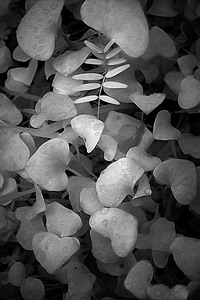
The rules for shooting with an infrared camera are a little different.
- You must use manual mode because the meter is still using visible light.
- Because of the conversion to infrared and focus differences, optimum results must use f/11 or smaller.
- You must do some post processing in Photoshop because the range of tones in the initial histogram is limited.
- The recommendation is that you should use custom white balance. I did not try this out yet because I do not know how to set it in my D30. Consequently, all my images came out of my camera with a strong magenta cast. I then used the green channel for the black and white conversion. I will have to rummage for my manual.
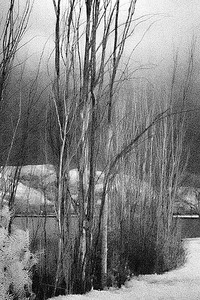
Wow, infrared is a lot of fun. I still need a lot of practice, but part of the fun for me is the surprise of the outcome. Hopefully as I get more experience, I will post more and more infrared images. My only regret is the Canon D30 cannot hold a candle to my Canon 20D in terms of resonsiveness and noise reduction.
Note:If you click on the leaf image, you will see a lot of noise. I shot on my D30 with ISO 400 forgetting just how much noise there would be. I am now spoiled by my Canon 20D.
 DorothyPhoto